[AddInfographic]
When you live in Phoenix, you know the “pool deck shuffle.” It is that frantic, tiptoed sprint from the back door to the water’s edge because the ground is literally hot enough to fry an egg. We have measured standard gray concrete at over 150°F on a typical July afternoon.
That kind of heat is not just uncomfortable. It is a legitimate safety hazard for children and pets.
We have spent years doing cool deck resurfacing across the Valley, and the most common question we get is simple: “Does Cool Deck actually work, or is it just marketing?” The short answer is yes, but the science behind why it works is fascinating.
Let’s break down the physics, the real-world numbers, and the difference between the “Kool Deck” brand and modern acrylic overlays.
The Physics of Hot Concrete
To understand why your feet burn, you have to look at how standard concrete interacts with our intense desert sun.
Solar Reflectance and Absorption
When sunlight hits your patio, the energy is either reflected back into the atmosphere or absorbed into the slab.
Standard concrete acts like a heat sponge. It typically absorbs about 65-70% of the solar energy hitting it. This absorbed energy excites the molecules in the concrete, raising its temperature significantly higher than the air temperature.
Absorption rates by material:
- Black asphalt: 95% (Absorbs almost everything)
- Dark concrete: 75-80%
- Standard gray concrete: 65-70%
- Cool Deck (Acrylic): 40-50% (Reflects half the heat)
Thermal Mass and Emittance
Concrete is dense, meaning it has high thermal mass. Once it gets hot, it stays hot.
A standard slab will hold onto that heat long after the sun goes down, radiating it back up at you during your evening swim. This is known as “thermal emittance,” and it is the reason your pool area feels like an oven even at 8:00 PM.
The Two Types of “Cool Deck”
Before we get into the cooling mechanics, we need to clear up a massive confusion in our industry. Most people use “Cool Deck” as a generic term, like Kleenex, but there are actually two very different materials.
1. Mortex Kool Deck (The Original)
This is the trademarked product invented in Tucson in 1962. It is a cementitious topper made of white cement and marble sand.
- The Pro: It is incredibly cool because it is porous and breathable.
- The Con: It must be applied to freshly poured concrete while it is still curing. You cannot easily put this on an existing deck without tearing everything out.
2. Acrylic Lace (The Modern Standard)
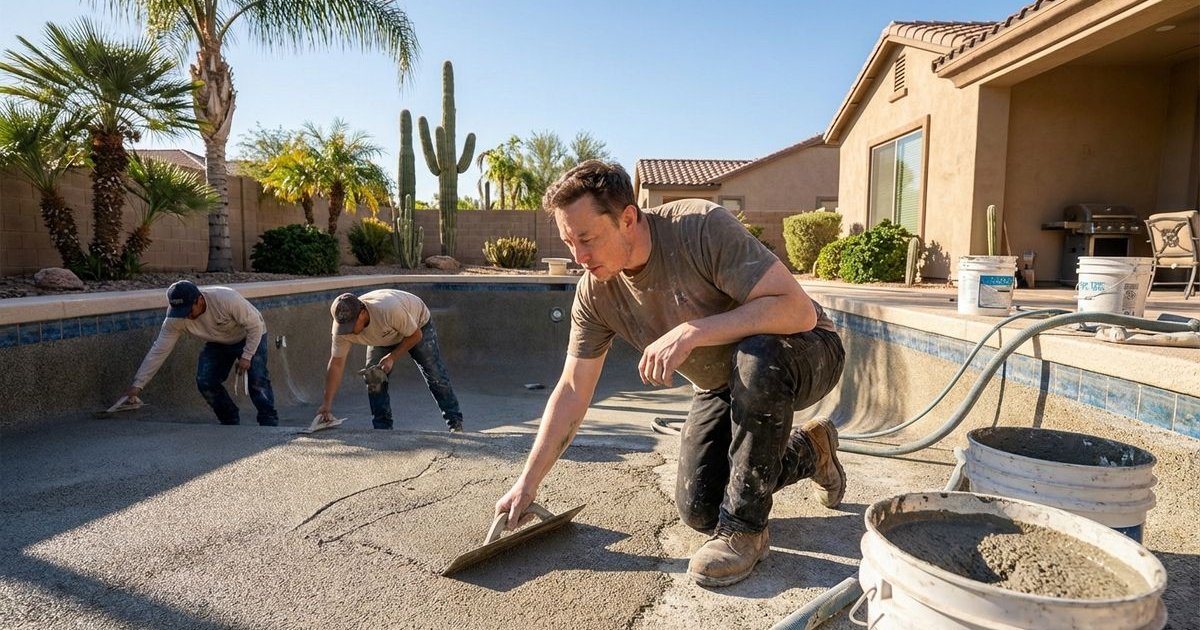
This is what we install on 90% of renovations for pools that are 10-15 years old. It is an acrylic-modified cement texture that can be applied over your existing concrete.
- The Pro: It is flexible, stain-resistant, and can be applied without demolition.
- The Con: Because it is sealed, it runs slightly warmer than the original Mortex, but modern reflective pigments have largely closed this gap.
How Cool Deck Reduces Temperature
We rely on three specific physical properties to keep your feet safe.
1. High Solar Reflectance (SRI)
Modern acrylic coatings are engineered with pigments that have a high Solar Reflectance Index (SRI).
White matters: A specialized white or cream coating can reflect up to 70% of solar radiation. We have seen a simple color change from dark gray to “sandstone” drop surface temperatures by over 20 degrees.
2. The “Knockdown” Texture
The classic, bumpy texture you feel underfoot is not just for grip; it is a cooling mechanism.
The “lace” or “knockdown” pattern creates thousands of tiny hills and valleys.
- Air Pockets: The texture traps microscopic pockets of air, which is a terrible conductor of heat.
- Surface Area: When you walk on it, your foot is only touching the “peaks” of the texture, effectively reducing the contact area between your skin and the hot surface.
3. Thermal Insulation
Unlike solid concrete, the acrylic layer does not store heat as densely. The thin application (usually 1/8 to 1/4 inch) heats up, but it sheds that heat much faster than the 4-inch slab of concrete beneath it.
Temperature Comparison: Real Numbers
We gathered data on surface temperatures during a 110°F Phoenix day to show you the difference. Note that skin damage can occur in just one second at 158°F.
| Surface Material | Surface Temp | Burn Risk |
|---|---|---|
| Black Asphalt | 160°F+ | Extreme: Instant damage |
| Dark Concrete | 150°F+ | High: Burns in < 2 seconds |
| Standard Gray Concrete | 140-145°F | High: Painful immediately |
| Basic Cool Deck | 115-125°F | Moderate: Uncomfortable but safe |
| Premium Reflective Deck | 105-115°F | Low: Walkable barefoot |
The key takeaway: A 30-degree drop does not make the deck “cold,” but it moves the temperature from “dangerous” to “manageable.”
Maximizing Performance: Insider Tips
We tell every homeowner that a Cool Deck is a system, and like any system, it needs the right conditions to work.
Avoid Dark Colors
You cannot cheat physics. Even with “cool” technology, a dark brown or charcoal deck will still get hot.
- Our Recommendation: Stick to colors with names like “Ivory,” “Sand,” “Cream,” or “Silver.” These have the highest Light Reflectance Value (LRV).
The “Must-Do” Maintenance
Dirt destroys reflectivity. A dirty deck is a darker deck, which means it absorbs more heat.
- Pro Tip: Do not use muriatic acid to clean your acrylic deck. Acid can etch the sealer and damage the texture. Use a simple mix of water and a pH-neutral cleaner (like Simple Green) or a mild house-wash mix with a soft-bristle brush.
Keep the Texture Sharp
If your deck has been painted over multiple times, the texture might be filled in. Once that texture is smooth, you lose the air-gap insulation, and the deck will feel hotter.
Alternatives: How They Compare
If you are renovating, you have options beyond acrylic lace. Here is how they stack up in the Phoenix market for 2026.
| Material | Est. Cost (Phoenix) | Cooling Ability | Longevity |
|---|---|---|---|
| Acrylic Cool Deck | $4 - $8 / sq ft | Good | 10-15 Years |
| Travertine Pavers | $11 - $15 / sq ft | Excellent | 25+ Years |
| Stamped Concrete | $8 - $15 / sq ft | Poor (often sealed/dark) | 15-20 Years |
| Rubber/Foam | $6 - $10 / sq ft | Very Good | 5-10 Years |
Travertine vs. Cool Deck: Travertine is naturally porous and stays incredibly cool, often cooler than acrylic. However, it typically costs 2-3 times more to install.
Is Cool Deck Right for Your Pool?
We generally recommend acrylic Cool Deck if:
- Your budget is tight: You want a fresh look without the $15k+ price tag of pavers.
- Your concrete is sound: You have minor cracks but the slab is structural.
- You want easy maintenance: You want a seamless surface that is easy to hose off.
Consider upgrading to Travertine if:
- You have major cracking: Concrete overlays will eventually mirror the cracks beneath them. Pavers “float” and handle ground movement better.
- You want a luxury aesthetic: Natural stone adds significant resale value.
Get Expert Advice
If your pool deck is showing its age, do not guess at the solution. We are happy to assess your current setup, measure your surface temperatures, and give you an honest recommendation on whether a resurface or a replacement is your best move.
Contact us or call (602) 619-1234 to schedule your evaluation.