Deciding between standard plaster and an aggregate finish like Pebble Tec is easily the biggest choice you will face during a pool resurfacing renovation.
We see this debate play out in backyards across the Valley every single week.
The right answer almost always comes down to your timeline and how much maintenance you want to handle during our blistering summers.
David Resurface was founded with a simple mission: to provide exceptional pool remodeling and resurfacing services that customers can truly rely on.
We have applied thousands of finishes throughout Phoenix and Scottsdale.
Experience has taught us that while the initial price tag matters, the “cost per year” is the metric that actually affects your wallet.
This guide breaks down the data, the durability factors, and the real-world performance of both finishes in the Arizona climate.
Quick Comparison: The 2026 Snapshot
Prices for raw materials, particularly cement and specialized aggregates, have shifted significantly in recent years.
We have compiled this comparison based on current Phoenix-area market trends for a standard play pool (roughly 80-90 perimeter feet).
| Feature | Standard White Plaster | Pebble Tec (Aggregate) |
|---|---|---|
| Estimated Cost | $6,000 - $8,500 | $10,500 - $16,000+ |
| Expected Lifespan | 7-10 years (Max) | 20-25+ years |
| Texture Feel | Smooth (until etched) | Textured (like river rock) |
| Hard Water Tolerance | Low (Stains easily) | High (Hides scale) |
| Warranty Standard | 2-5 years | 10 years - Lifetime |
| Curing Time | 28 days (High maintenance) | 1-2 days (Acid wash process) |
Understanding Pool Plaster (The Traditional Choice)
White plaster, sometimes called marlcite, has been the industry standard since the 1960s.
It consists of a simple mixture of white Portland cement, marble dust, and water.
This mix is troweled over the gunite shell to create a watertight seal.
Plaster Pros
- Lowest Initial Investment: Plaster remains the most affordable option upfront, usually saving you $4,000 to $6,000 compared to aggregate.
- Classic “Pool Water” Look: Nothing replicates that brilliant, crisp light blue water color quite like fresh white plaster.
- Smooth Surface: Your feet will appreciate the lack of texture, as healthy plaster is sleek and snag-free.
Plaster Cons
- Softness and Porosity: Plaster is relatively soft, meaning aggressive water chemistry can pit and etch the surface quickly.
- The “Rough Toe” Effect: As calcium leaches out over time, the surface becomes like sandpaper, often scraping the toes of children and swimmers.
- High-Maintenance Start-Up: New plaster requires a rigorous brushing schedule (twice a day for two weeks) to remove plaster dust and prevent streaking.
- Algae Susceptibility: The porous nature of marlcite gives algae roots a place to grab hold, requiring more frequent brushing and chemical shocks.
Insider Tip: In Phoenix, we often see plaster fail prematurely due to “spot etching.” This happens when the pH drops too low, even briefly. Because plaster has no stone aggregate to protect the cement, the acid eats the surface immediately.
Understanding Pebble Tec (The Aggregate Solution)
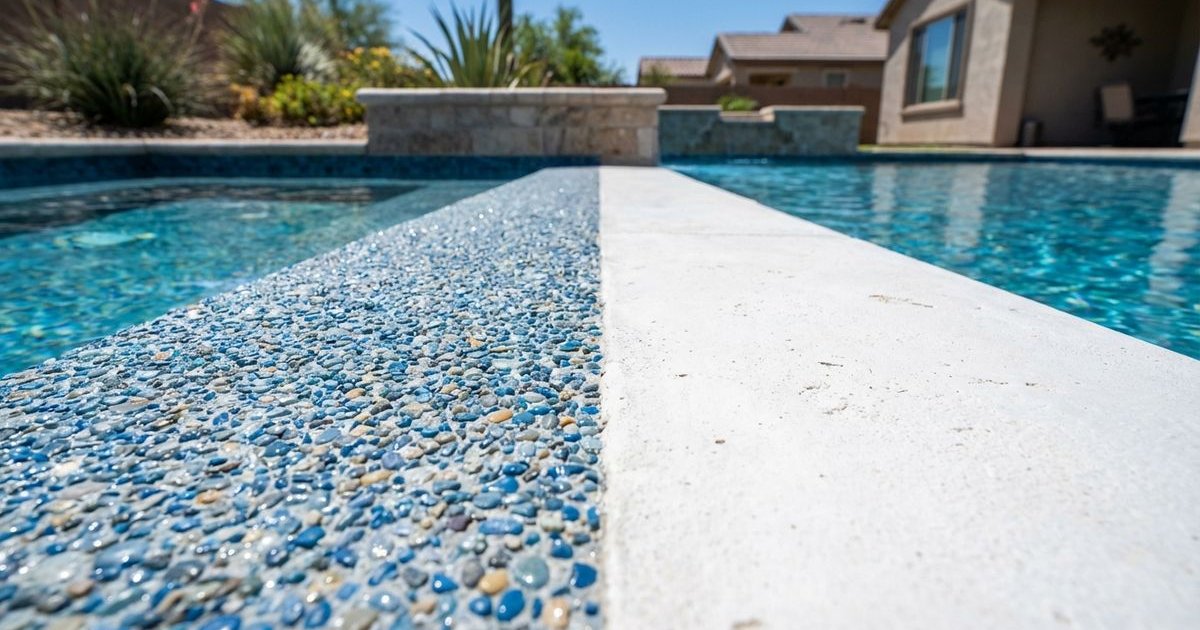
Pebble Tec is a brand name that has become the generic term for “exposed aggregate” finishes.
These finishes mix hydraulic cement with small pebbles, glass beads, or crushed stone.
Installation involves troweling the mix and then spraying off the top layer of cement to reveal the stone underneath.
Pebble Tec Pros
- Superior Durability: The stones take the brunt of the chemical wear and tear, protecting the cement binder underneath.
- Stain Camouflage: Unlike the solid white canvas of plaster, the speckled pattern of pebbles hides slight dirt, debris, and scaling from hard water.
- Structural Integrity: Aggregate finishes are harder and denser, adding a layer of structural strength to the pool shell.
- Modern Aesthetics: Options range from deep ocean blues (using black and blue stones) to sandy beach tones (using gold and tan stones).
Pebble Tec Cons
- Texture Sensitivity: Standard “Pebble Tec” utilizes larger stones that some swimmers find rough on sensitive feet.
- Cost Barrier: The specialized application process and patented materials drive the price up significantly.
- Scale Buildup Visibility: While it hides stains, the calcium scale common in Arizona can create a white “haze” on darker pebble colors if water chemistry is ignored.
Solving the Texture Issue: Mini-Pebble & Polish
If you love the durability of pebble but hate the rough texture, you have options.
We frequently install “Mini-Pebble” (like Pebble Sheen) or polished aggregates (like Pebble Fina or Hydrazzo).
These use significantly smaller stones or are polished flat after application to provide the smoothness of plaster with the strength of stone.
Performance in Arizona: The Environmental Test
Arizona is arguably the harshest environment in the United States for pool surfaces.
Your finish must survive massive temperature swings and aggressive water conditions.
1. The Calcium Hardness Battle
Phoenix municipal water is extremely hard, often coming out of the tap at 250+ ppm (parts per million) of calcium hardness.
As water evaporates, that calcium stays behind.
The Verdict: Pebble finishes win here. High calcium levels lead to scale deposits. On white plaster, these deposits are rough and attract dirt, turning gray or black. Pebble surfaces hide this scaling much better and are more resistant to the chemical scraping needed to remove it.
2. Thermal Shock and Blistering
Summer surface temperatures in a drained pool can hit 140°F, while winter nights drop below freezing.
Plaster is more prone to “delamination” (popping off the shell) when subjected to these thermal cycles over many years.
The Verdict: The aggregate matrix in Pebble Tec allows for better expansion and contraction without cracking.
3. UV Degradation
With 300+ days of intense sunshine, UV rays bleach organic dyes and break down binders.
The Verdict: Natural stone does not fade. The color of a pebble pool comes from the rock itself, whereas colored plaster relies on pigments that will fade and look blotchy within 2-3 years.
Cost Analysis Over Time
You should view this purchase as an amortization calculation rather than a one-time receipt.
Most homeowners stay in their Phoenix homes for an average of 10-13 years.
The 15-Year Scenario
Option A: Pool Plaster
- Year 1: Install Plaster ($7,000)
- Year 8: Plaster creates rough surface/stains. Resurfacing needed ($8,500 factoring inflation).
- Chemicals: Higher monthly acid demand to balance pH.
- Total 15-Year Cost: ~$15,500+ (plus inconvenience of draining twice).
Option B: Pebble Tec
- Year 1: Install Pebble ($12,000)
- Year 15: Surface still functional. Maybe a light acid wash needed ($600).
- Total 15-Year Cost: ~$12,600.
The Bottom Line: If you plan to keep the house for more than 7 years, the aggregate finish is mathematically cheaper.
Which Should You Choose?
Choose Plaster If:
- You are selling soon: If you are listing the home in the next 2-3 years, you likely won’t recoup the full investment of a pebble finish.
- Budget is the only driver: Sometimes the budget is fixed, and a clean, white plaster pool is still a beautiful upgrade from a damaged one.
- You want a retro vibe: For mid-century modern homes in neighborhoods like Haver or Ralph Haver communities, white plaster offers that authentic vintage aesthetic.
Choose Pebble Tec If:
- This is your “Forever Home”: You want to do this once and never think about it again.
- You have a salt system: Salt water generators create high pH environments that are very aggressive on standard plaster. Aggregate is essential for salt pools.
- You want modern color: You want the water to look teal, deep blue, or lagoon green rather than standard light blue.
Middle Ground: Quartz Aggregate
There is a third option that sits between these two extremes.
Quartz finishes (like Diamond Brite) replace the marble dust in plaster with crushed quartz.
- Price: Mid-range ($8,000 - $10,000).
- Durability: 12-15 years.
- Texture: Very smooth.
- Arizona Performance: Better than plaster, but not as bulletproof as pebble.
Our Recommendation
For 90% of the Arizona homeowners we work with, an aggregate finish (Pebble Tec, Pebble Sheen, or similar) is the correct decision.
The slightly higher upfront cost pays for itself by eliminating the need for a second renovation a decade down the road.
However, we understand that every budget has limits.
If plaster is the right choice for your financial situation, we can discuss adding “pozzolans” (silica-based additives) to the mix to extend its life and durability.
We’re happy to discuss your specific situation and help you choose the best finish for your pool and budget. Contact us for a free consultation.