From what we see in the field, owning a pool in the Grand Canyon State is a unique challenge. Arizona pools face a brutal trifecta: triple-digit heat, aggressive hard water, and relentless UV exposure.
We founded David Resurface because we saw how quickly these elements could destroy a beautiful backyard oasis.
The Complete Pool Maintenance Schedule for Arizona Homeowners isn’t just about clear water. It is about protecting your investment.
Proper maintenance prevents the premature failure of your plaster and pool equipment.
This guide breaks down exactly what needs to be done to keep your pool surviving and thriving in the desert.
Daily Tasks (5-10 Minutes)
Quick Visual Inspection and Water Level
We advise starting every morning with a simple glance at your water line.
Arizona’s evaporation rate is staggering. During July and August, a standard 400-square-foot pool loses about 50 gallons of water daily (roughly a quarter-inch). If the level drops below the skimmer intake, your pump will suck air and overheat.
Pro-Tip: Keep the water level at the mid-skimmer mark.
Empty Skimmer Baskets
We cannot stress this enough: airflow is everything.
Debris from mesquite trees, palo verdes, and desert landscaping clogs baskets rapidly. A full basket cuts off water flow. This strains your pump and ruins filtration.
Make it a habit to dump these out daily.
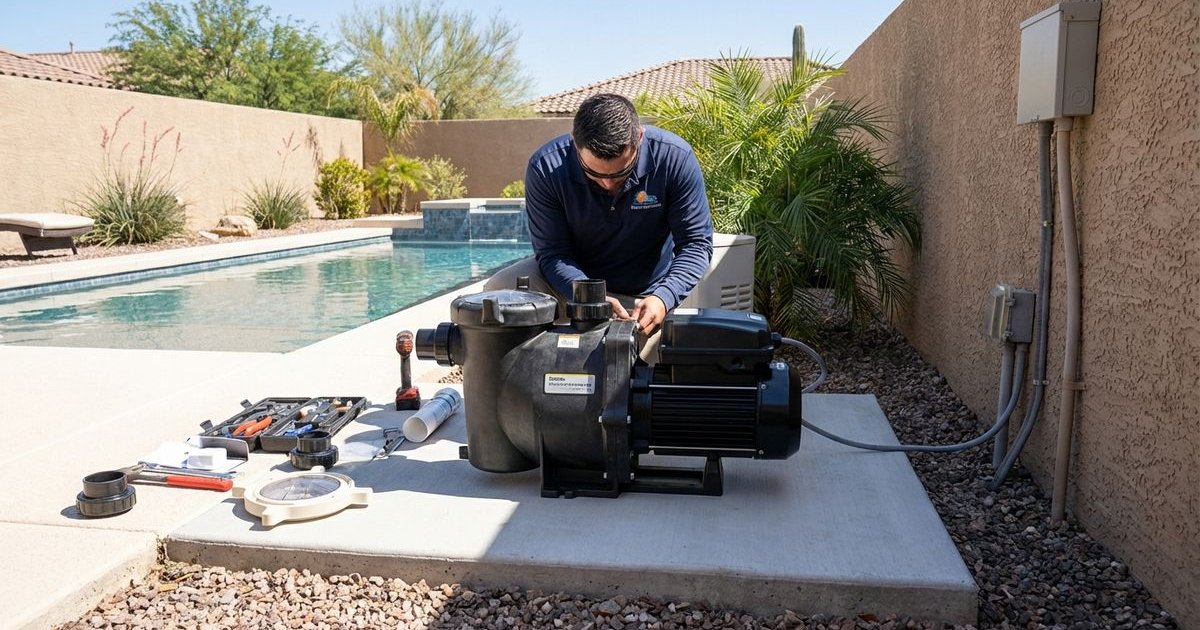
Check Pump Operation
Listen to your equipment.
You should hear a smooth, consistent hum. Grinding or screeching noises often indicate bearing failure, which is common in older motors exposed to our heat. Ensure the pump is running its full scheduled cycle.
Weekly Tasks (30-60 Minutes)
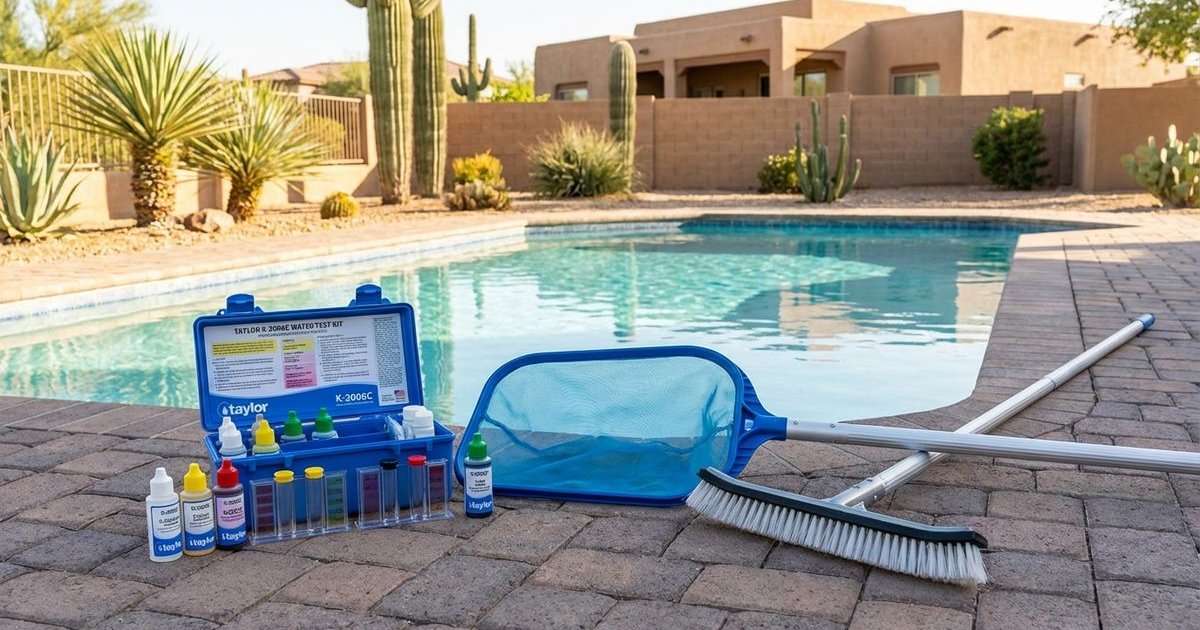
Test Water Chemistry
We see countless pools with damaged surfaces due to ignored chemistry.
You need to test your water at least once a week. In the peak of summer, testing twice a week is safer because chlorine burns off rapidly in UV index 10+ days.
Use this chart as your baseline for Phoenix-area water:
| Parameter | Ideal Range | Why It Matters in Arizona |
|---|---|---|
| pH | 7.4 - 7.6 | pH naturally rises here. High pH causes calcium scale on your tile and salt cells. |
| Free Chlorine | 3.0 - 5.0 ppm | The standard 1 ppm is too low for AZ summers. Algae grows fast at 90°F+ water temps. |
| Total Alkalinity | 80 - 120 ppm | Acts as a buffer for pH. It prevents rapid acidity swings. |
| Cyanuric Acid (CYA) | 30 - 50 ppm | Protects chlorine from the sun. Warning: Too high (100+) renders chlorine useless. |
Adjust Chemistry
We recommend using liquid chlorine during the summer rather than relying solely on tablets.
Trichlortabs contain Cyanuric Acid (stabilizer). Since Arizona pools aren’t backwashed often (thanks to cartridge filters), this stabilizer builds up. High stabilizer levels force you to drain the pool sooner.
Add muriatic acid carefully to lower pH.
Brushing Walls and Steps
Dust settles on the walls and floor, creating a biofilm where algae roots.
We find that automatic cleaners often miss tight corners, steps, and benches. Give these areas a vigorous brush weekly. This is especially critical for older plaster surfaces that have become rough or pitted over time.
Clean the Waterline
Arizona water is packed with calcium and magnesium.
As water evaporates, it leaves these minerals behind on your tile. We suggest wiping the waterline weekly with a mild tile cleaner or a mix of vinegar and water. Once that white line hardens into silicate scale, it requires professional bead blasting to remove.
Bi-Weekly Tasks
Inspect Cleaning Systems
We find that pop-up heads often get stuck in the “up” position due to sand or small rocks.
Check that your in-floor cleaning heads are rotating. If you use a suction-side vacuum or robot, check its throat and canister for blockages. A jammed cleaner wears out its internal gears quickly.
Monitor Filter Pressure
Check the pressure gauge on your filter tank.
We look for a rise of 8-10 PSI above the “clean” starting pressure. If your clean pressure is 15 PSI and it reads 25 PSI, the system is struggling to push water through the dirty cartridges.
Monthly Tasks
Deep Clean Filters
Cartridge filters are the standard in Phoenix.
We recommend removing the cartridges and hosing them down thoroughly monthly during the swim season. Pay attention to the bands around the cartridges. If they are frayed or the plastic end caps are cracked, it is time for replacements.
Test Calcium Hardness
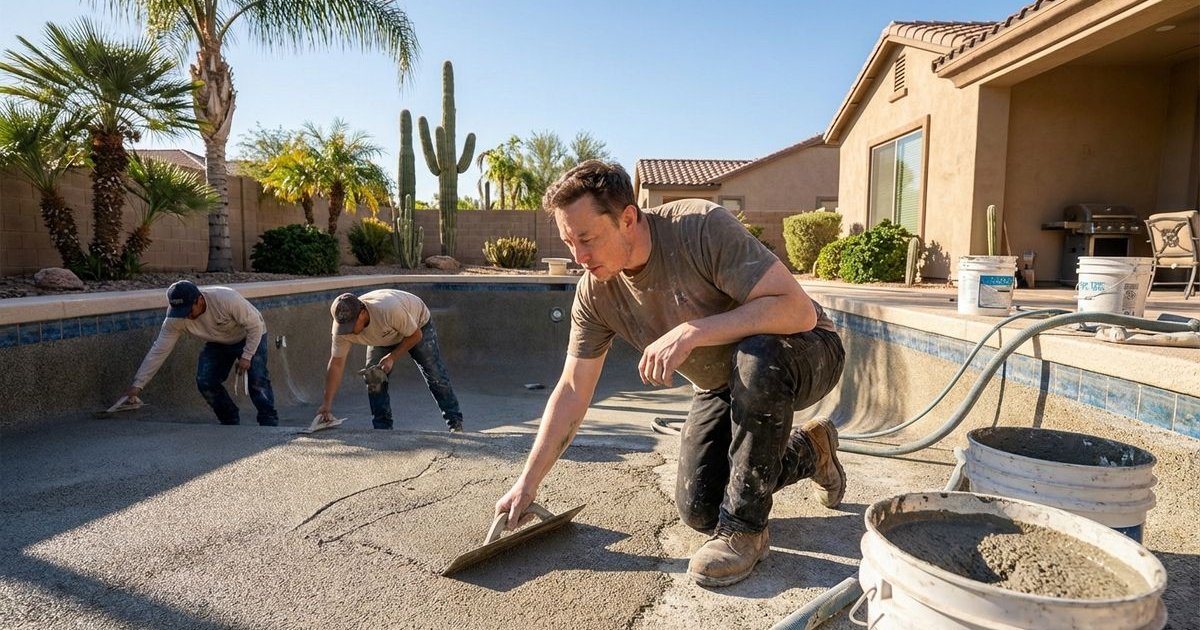
We deal with this issue on nearly every resurfacing project.
Phoenix tap water often comes out of the hose at 200+ ppm (parts per million) of calcium hardness. As water evaporates, calcium stays behind and concentrates.
The Danger Zone:
- Levels above 800 ppm: You will see scale deposits on your spillways and decorative tile.
- Levels above 1000 ppm: The water becomes difficult to balance and feels chemically harsh on skin.
Langelier Saturation Index (LSI) Check
We encourage using an app to check your LSI.
This formula considers temperature, pH, alkalinity, calcium, and TDS (Total Dissolved Solids). It tells you if your water is corrosive (eating your plaster) or scale-forming (clogging your pipes). Balanced LSI is the secret to making a pool finish last 20 years instead of 10.
Seasonal Maintenance Plan
Spring (March-April)
We use this time to prep for the heat.
- Ramp up pump runtimes: Move from 6 hours to 8-10 hours.
- Check the salt cell: Acid wash the cell if there is buildup (for saltwater pools).
- Inspect the weir gate: That flapping door in the skimmer is vital for skimming action.
Summer (May-September)
We shift into defense mode against the sun.
- Maximize Circulation: Run pumps 10-12 hours a day.
- Energy Savings: Program your Variable Speed Pump to run at high speed only when necessary (cleaning cycle). Run it at low speed (1500-2000 RPM) for the rest of the time to save huge money on SRP or APS bills.
- Chlorine Demand: Monitor levels closely. A pool party or a dust storm can deplete chlorine to zero in hours.
Monsoon Season Specifics (July-August)
We see pools turn green overnight during this season.
Haboobs (dust storms) dump tons of phosphates and nitrogen into the water. This is essentially “algae food.”
- Immediate Action: Clean skimmers right after a storm.
- Shock the Pool: Add liquid chlorine immediately to counter the organic load.
- Phosphate Remover: Consider using a phosphate remover product to starve potential algae.
Fall (October-November)
We advise cooling things down as the air temperature drops.
- Reduce Pump Times: Dial back to 6-8 hours.
- Clean Filters: Do a major deep clean to remove all the summer sunscreen oils and monsoon dust.
- Check Sensors: Ensure air and water temperature sensors are reading correctly.
Winter (December-February)
We don’t “close” pools here, but we do slow down.
- Freeze Protection: Ensure your pump has a freeze guard mode. It should automatically turn on if the air temp drops below 36°F to prevent pipes from cracking.
- Chemistry: pH tends to rise faster in cold water. Keep an eye on it.
- Pump Runtime: 4-6 hours is usually sufficient.
Annual Tasks
Professional Equipment Audit
We recommend having a pro inspect your motor capacitors and seals.
Small leaks often go unnoticed until they destroy a $800 motor. A yearly checkup catches these $20 O-ring fixes before they become expensive replacements.
The “Drain and Refill” Schedule
Arizona pools usually need draining every 3-5 years.
We use Total Dissolved Solids (TDS) and Cyanuric Acid levels as the deciding factor. If your TDS is over 3,000 ppm (non-salt pool) or CYA is over 100 ppm, no amount of chemicals will fix the water. You must drain and refill.
Surface Inspection
Look closely at your plaster or pebble surface.
We check for:
- Delamination: Hollow spots where plaster has separated from the concrete shell (tap it with a golf ball; hollow spots sound like a drum).
- Cracks: Structural cracks usually run through the shell, while check cracks are just surface shrinkage.
- Etching: Rough texture that feels like 60-grit sandpaper, caused by aggressive water chemistry.
When to Call a Professional
Some issues are beyond DIY maintenance.
We suggest calling for backup if you encounter:
- Structural Cracks: Any crack wider than a business card needs expert evaluation.
- Persistent Algae: If shocking doesn’t kill it, you may have high phosphates or a filtration failure.
- Loud Equipment: Screaming motors usually mean immediate bearing replacement is needed.
- Pop-offs: If patches of plaster pop off the floor, your surface is failing.
Need Help With Maintenance?
Keeping an Arizona pool pristine requires consistency and knowledge.
If your pool surface is showing its age or the maintenance has become a burden, Contact us or call (602) 619-1234. We are here to help you get your backyard back to perfect condition.