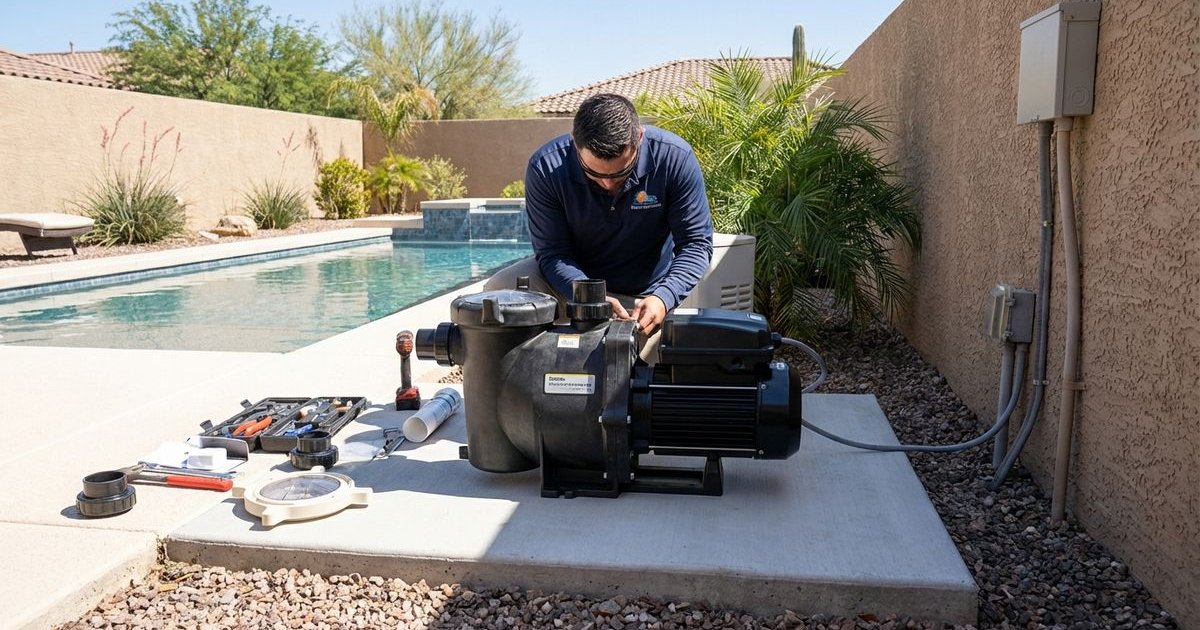
Your pool pump is the heart of your pool’s circulation system. When it fails, or just gets too expensive to run, knowing your pool equipment repair options can save you money and headaches.
David Resurface was founded with a simple mission: to provide exceptional pool remodeling and resurfacing services that customers can truly rely on. From what we have seen in Phoenix backyards, the pump is often the most overlooked piece of equipment until silence falls over the pool equipment pad.
This guide breaks down exactly why newer pumps are different and how to choose the right one for your setup.
Signs Your Pump Needs Replacement
We often get calls where a simple repair might suffice, but there are clear indicators that a full replacement is the smarter financial move.
Definite Replacement Signs
If you notice these symptoms, the internal damage is usually extensive enough to warrant a new unit.
- Motor won’t start: This applies even after you have verified the breaker is on and the wiring is intact.
- Grinding or screeching noises: These sounds usually indicate bearing failure where the metal parts are grinding against each other.
- Leaking from the motor: Water dripping from the actual motor housing suggests a cracked casing, unlike simple drips from PVC fittings.
- Burning smell: A scent of burnt ozone or plastic from the motor often means the windings have shorted out.
- Pump is 10+ years old: Equipment past the decade mark in the Arizona heat often suffers from heat fatigue that makes repairs temporary at best.
Maybe Repair, Maybe Replace
Sometimes a $50 part is all you need.
- Pump runs but doesn’t move water: The impeller might be clogged with debris, which is a simple fix.
- Leaking from shaft seal: A puddle directly under the connection between the motor and the “wet end” usually means a $30 seal replacement is in order.
- Pump loses prime frequently: This is often a suction-side air leak in the PVC pipes rather than a pump failure.
- Humming but not starting: A bad capacitor is the culprit in about 70% of these cases and is relatively cheap to swap.
Pool Pump Types Explained
The market shifted drastically after the Department of Energy (DOE) regulations took full effect in July 2021. These federal rules changed what manufacturers can legally build.
Single-Speed Pumps
These were the standard for decades but run at full power every second they are on.
Pros:
- Lowest purchase price: You can still find remaining stock or smaller units for $400-800.
- Simple technology: They use basic induction motors that are easy for any technician to service.
- Easy to repair: Parts are widely available generic components.
Cons:
- Highest operating cost: They consume energy like a classic V8 engine idling at full throttle.
- Loud operation: Most run at 65-80 decibels, which is about as loud as a vacuum cleaner.
- Regulatory restrictions: The DOE has effectively banned the manufacturing of most single-speed pumps over 1.0 Total Horsepower (THP).
Dual-Speed Pumps
These units offer a high speed for cleaning and a low speed for circulation.
Pros:
- Lower operating cost: Running on low speed can drop energy usage significantly compared to single-speed models.
- Affordable entry point: Prices generally range from $600 to $1,000.
- Quieter operation: The low-speed setting is much easier on the ears.
Cons:
- Obsolescence risk: Manufacturers are phasing these out in favor of variable-speed technology.
- Limited flexibility: You are stuck with two rigid speeds rather than customizable flow rates.
- Efficiency gap: They still use induction motors, which are less efficient than the magnet motors in newer pumps.
Variable-Speed Pumps (VSPs)
These are the modern standard and operate much like an electric car. They utilize permanent magnet motors rather than induction coils.
Pros:
- Massive energy savings: Homeowners typically see energy use drop by up to 90%.
- Whisper quiet: Many models, like the Pentair IntelliFlo series, run as quietly as 45 decibels (library silence) at low speeds.
- Longer lifespan: The motor runs cooler and with less vibration, reducing wear and tear.
- Better filtration: Running water slowly allows your filter media to trap smaller particles effectively.
- Regulatory compliance: These meet all current DOE and Arizona Title 44 standards.
Cons:
- Higher upfront investment: Hardware costs sit between $1,200 and $2,500.
- Complex electronics: The drive assembly is a computer that is sensitive to power surges.
- Professional programming required: To get maximum savings, the RPMs must be tuned to your specific plumbing curve.
The Math: Energy Savings Are Real
We track energy rates closely because the payback period on these pumps is faster in Phoenix than almost anywhere else.
Arizona Energy Costs
Electricity rates have climbed. As of early 2026, the average residential rate for customers on standard plans with APS or SRP hovers around $0.15 to $0.18 per kWh, with peak summer rates going much higher.
Monthly Operating Cost Comparison
The difference in your monthly bill is stark.
| Pump Type | Daily Runtime | Monthly Cost (Est.) |
|---|---|---|
| Single-speed (1.5 HP) | 8 hours | $130 - $160 |
| Variable-speed (Low RPM) | 12 hours | $18 - $35 |
| Monthly Savings | $110+ per month |
Annual Savings
A variable-speed upgrade can save a Phoenix homeowner $1,000 to $1,500 per year.
Most of our clients recoup the equipment cost in roughly 18 months. After that point, the pump is essentially paying you to own it compared to the old one.
Replacement Costs Breakdown
Budgeting accurately prevents surprises during the project.
Pump Only (DIY Install)
If you buy the unit yourself online:
- Single-speed: $400-800 (Limited availability).
- Variable-speed: $1,200-2,500 depending on Horsepower and automation features.
Professional Installation
Hiring a licensed contractor ensures warranty coverage.
- Pump + install (single-speed): $800-1,200.
- Pump + install (variable-speed): $1,800-3,000.
- Pump + plumbing modifications: Add $200-500 if we need to re-plumb the suction side or replace valves.
What Installation Includes
Our standard service covers the complete transition.
- Removal: We take away and recycle the old motor and wet end.
- Installation: Mounting the new pump and bonding it to the grid.
- Electrical: Connecting the high-voltage lines and ensuring the bond wire is secure.
- Programming: Setting custom schedules (e.g., a high-speed skim for 2 hours, low-speed circulation for 8 hours).
- System Check: Verifying there are no leaks and the prime holds.
Choosing the Right Size
Bigger isn’t always better. In fact, an oversized pump can cause cavitation, which destroys the impeller.
Sizing Factors
We look at specific hydraulic metrics to size a pump correctly.
- Turnover Rate: The goal is to move the entire volume of your pool through the filter once every 24 hours (for residential pools).
- Total Dynamic Head (TDH): This measures the resistance in your pipes caused by distance, elevation, and filter type.
- Plumbing Diameter: A 3HP pump on 1.5-inch piping will screech and fail prematurely due to friction.
- Water Features: Waterfalls and spas require higher flow rates (GPM) than basic filtration.
We will calculate proper sizing during your consultation using industry-standard flow charts.
Variable-Speed Features to Consider
Not all VSPs are created equal.
Look For:
- Rotatable Keypad: This allows you to orient the screen for easy viewing regardless of how the pump is plumbed.
- Automation Compatibility: Ensure the pump speaks the same “language” as your automation system (e.g., Pentair pumps work best with Pentair EasyTouch).
- Freeze Protection: The pump should sense air temperature and turn on automatically at 34°F to prevent pipe bursts.
- TEFC Motor Design: Totally Enclosed Fan Cooled motors prevent dust and rain from entering the motor housing.
- Warranty Duration: Look for extended warranties (3 years) that are often exclusive to professional installations (“TradeGrade”).
Top Brands We Install
Reliability is our primary filter for choosing equipment.
- Pentair IntelliFlo3: The current market leader. It features a touchscreen and app control without needing a separate automation hub.
- Hayward TriStar VS: Excellent for high-flow requirements and known for its energy calculator interface.
- Jandy VS FloPro: A compact option that fits perfectly in tight equipment pads often found in older Phoenix homes.
Installation Considerations
Replacing a pump is rarely a simple “plug and play” operation due to safety codes.
Electrical Requirements
Modern pumps have sensitive digital drives.
- Dedicated 230V Circuit: While some small pumps run on 115V, most robust VSPs need 230V.
- Bonding Grid: We must connect the pump to the pool’s bonding loop using #8 AWG solid copper wire to prevent shock hazards.
- GFCI Protection: Current National Electrical Code (NEC) requires GFCI breakers for all pool pumps to prevent electrocution.
Plumbing Compatibility
Physical alignment often shifts during a swap.
- High-Temp Unions: We recommend installing heat-resistant unions to make future servicing easier.
- Straight Pipe Runs: To function correctly, a pump needs a run of straight pipe (usually 2-5 times the pipe diameter) entering the suction side.
- Valve Updates: If your diversion valves are brittle or leaking, this is the time to replace them.
Location and Ventilation
Heat is the enemy of electronics.
- Airflow: The fan on the back of the motor needs at least 3 inches of clearance from walls or shrubs.
- Sun Protection: While rated for outdoors, shielding the digital drive from the direct 2 PM Arizona sun extends its life.
- Foundation: The pump must be bolted to a level concrete pad to reduce vibration noise.
Rebates and Incentives
You can often get money back for making an energy-efficient choice.
Utility Rebates
Local providers want you to reduce load on the grid. APS and SRP frequently offer rebates for ENERGY STAR certified variable-speed pumps.
- Typical rebate: $150-$300 credited to your bill or sent as a check.
- Conditions: The pump usually must be installed by a licensed contractor and calibrated to specific speeds.
- Assistance: We provide the invoice and model numbers you need to file the claim immediately.
Federal Tax Credits
The Energy Efficient Home Improvement Credit (25C) was revamped recently. Certain high-efficiency biomass or electric upgrades may qualify, though pool pumps have specific caps. Consult your tax advisor for the latest eligibility on “Home Energy Audits” and efficiency improvements.
DIY vs Professional Installation
We support homeowners who are handy, but pumps carry specific risks.
DIY Possible If:
- You are replacing a motor with an identical model number.
- No high-voltage electrical modifications are required.
- You are comfortable cutting and gluing Schedule 40 PVC pipe.
- You own a multimeter to verify voltage.
Hire a Pro If:
- You are upgrading to variable-speed: The warranty on many top brands (like Pentair) drops from 3 years to 60 days if not professionally installed.
- Electrical work needed: Adding a GFCI breaker or running new wire requires a license.
- Plumbing is complex: If you have tight clearances or old copper plumbing, mistakes are costly.
- Programming is required: Setting the flow rates incorrectly can result in a green pool or a burned-out pump.
Ready to Upgrade?
A pool pump replacement is a significant decision, but the right choice pays dividends for years. We’re happy to assess your current setup and recommend the best option for your pool and budget.
Contact us or call (602) 619-1234 for a free consultation.