Should You Repair or Replace Your Pool Deck? A Decision Guide
Your pool deck has seen better days. The scorching sun and shifting soils in our region can turn a beautiful surface into a cracked, blistering eyesore. You are likely wondering if you can save it with a repair or if you need to rip it out entirely.
The answer isn’t always obvious. From what I have seen in years of inspecting decks, homeowners often rush to replace concrete that still has decades of life left in it. We want to help you avoid that expensive mistake.
Should You Repair or Replace Your Pool Deck? A Decision Guide determines the right path based on data, not just aesthetics. Let’s look at the numbers, the warning signs, and the practical tests you can do today.
Understanding Your Options
Repair and Resurfacing Options
Most “ruined” decks are actually just suffering from surface fatigue. We often recommend these solutions for cosmetic or minor structural issues.
- Acrylic Lace Coating: This is the modern evolution of the traditional “Cool Deck.” Our cool deck resurfacing costs significantly less than replacement and provides a slip-resistant, cool surface.
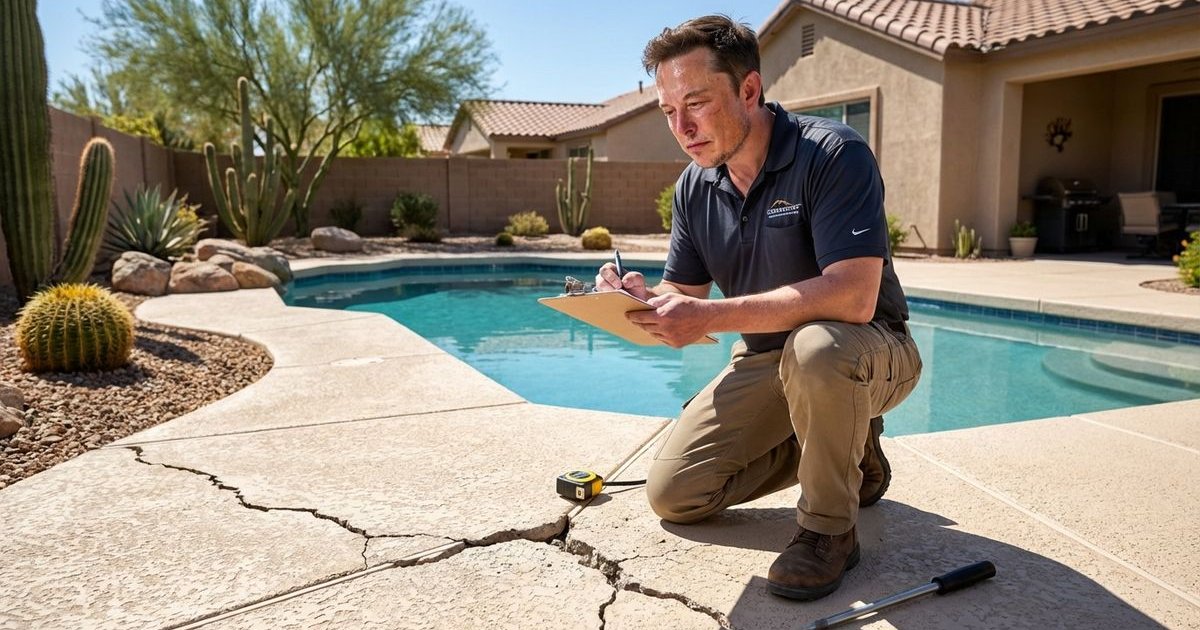
- Crack Repair & Stitching: We use high-strength epoxies or staples to bond cracks. This typically costs $400-$800 per major crack depending on the linear footage.
- Overlay Systems: These add a thin layer of high-strength cement over your existing slab. Prices generally range from $5-$10 per square foot for standard textures.
Replacement Options
Sometimes the damage goes too deep. If the concrete is failing, you have two main paths.
- Concrete Removal and Pour: This is labor-intensive. You are paying for demolition, disposal, and the new pour. Expect costs to reach $30-$55 per square foot when you factor in the tear-out.
- Pavers or Travertine: This is a popular upgrade in Phoenix. While materials like travertine stay cool, the installation involves removing the old deck and leveling the ground, often costing $15-$35 per square foot.
When Repair Makes Sense
The “Credit Card” Crack Test
Not all cracks are terminal. You can perform a simple diagnostic test right now using a standard credit card.
- The Test: Try to slide the edge of a credit card into the crack.
- The Result: A standard credit card is about 0.030 inches thick. If the card cannot fit, or fits snugly, the crack is likely a minor shrinkage crack.
- The Fix: These are excellent candidates for routing, filling, and resurfacing.
Worn But Solid Surfaces
A deck that looks ugly often has a solid structural core. We look for specific signs that the concrete underneath is healthy.
- Surface Texture: The coating may be worn smooth or peeling.
- Solid Sound: When you tap the concrete with a hammer or golf ball, it should sound solid, not hollow.
- Stable Levels: The slabs are still even with each other, meaning no tripping hazards exist.
Localized Damage
Accidents happen. Perhaps a heavy planter was dropped, or a specific area has salt damage.
- The Solution: We can perform a “patch and blend” repair.
- The Aesthetic: Skilled technicians can match the texture of the patch to the surrounding deck so the repair is virtually invisible after recoating.
When Replacement Is Necessary
The “Hollow Sound” Test (Delamination)
Concrete layers can separate over time. This is called delamination, and it is a deck killer.
- The Test: Drag a heavy chain across the deck or tap it with a hammer.
- The Result: You are listening for a hollow, drum-like sound.
- The Meaning: This sound indicates the concrete has separated from the ground or the top layer has separated from the base. If this affects more than 20% of your deck, replacement is usually the only viable option.
Severe Heaving or Settlement
Our local soil is notorious for expanding and contracting. This movement can physically break a concrete slab into independent, moving pieces.
Watch for these red flags:
- Trip Hazards: One slab is significantly higher (more than 1/4 inch) than the neighbor.
- Reverse Slope: Water pools near your home or the pool edge instead of draining away.
- Active Movement: Cracks that continue to widen year over year.
Extensive Structural Failure
Repairing a deck that has shattered is like putting a bandage on a broken leg. We recommend replacement if you see:
- Cracks wider than 1/4 inch running through the entire slab.
- Multiple cracks forming a “spiderweb” pattern.
- Evidence of rusting rebar (spalling) popping the concrete surface.
The Decision Matrix
Use this checklist to find your likely path.
Choose Repair If:
✅ You passed the “Credit Card Test” (cracks are narrow). ✅ The concrete sounds solid, not hollow. ✅ Drainage is still functioning correctly. ✅ You plan to sell the home in the next 3-5 years. ✅ Your budget is under $10,000.
Choose Replace If:
✅ You hear hollow spots over large areas. ✅ Slabs have shifted or lifted to create trip hazards. ✅ The deck is over 30 years old and showing deep fatigue. ✅ You want to change the shape or footprint of the deck. ✅ You are upgrading to premium materials like Travertine.
Cost Comparison Example (2026 Estimates)
Let’s look at the real-world math. Scenario: A typical 500-square-foot pool deck in Phoenix with moderate cracking and sun-faded paint.
The Repair Route
We focus on restoring the integrity and look of the existing slab.
- Crack repairs and leveling: $800
- Surface preparation (grinding/cleaning): $500
- New Acrylic Lace coating: $3,500
- Estimated Total: $4,800
The Replacement Route
This involves heavy machinery and demolition.
- Demolition and Disposal: $3,500
- New Concrete Pour (4000 PSI): $5,000
- New Acrylic Coating (New concrete needs it too): $3,500
- Estimated Total: $12,000
The Savings: You save approximately $7,200 by choosing repair. However, if the repair extends the life by only 3 years, replacement is the better long-term investment.
How We Assess Your Deck
We take a forensic approach to deck inspection. Our team looks for the root cause of the damage, not just the symptoms.
- Delamination Mapping: We use the chain-drag method to map out exactly where the concrete is hollow.
- Drainage Check: We verify that water flows to your drains or landscape, not into your pool or foundation.
- Crack Measurement: We measure width and depth to determine if the crack is structural or cosmetic.
- Joint Inspection: We check if your expansion joints (mastic) have failed, which is a common cause of deck shifting.
David Resurface was founded with a simple mission: to provide exceptional pool remodeling and resurfacing services that customers can truly rely on. Our transparent assessment means we will tell you if your deck is too far gone for us to fix.
Get an Expert Opinion
Making the wrong choice can cost you thousands. We are happy to visit your home, perform these tests, and give you a clear, data-backed recommendation.
You deserve to know exactly what is happening under your feet. Contact us or call (602) 619-1234 to schedule your deck evaluation.
Should You Repair or Replace Your Pool Deck? A Decision Guide is just the start; let us help you finish the project right.